Spray Foam vs. Fiberglass Insulation: Which Is Actually Better for Your Home?
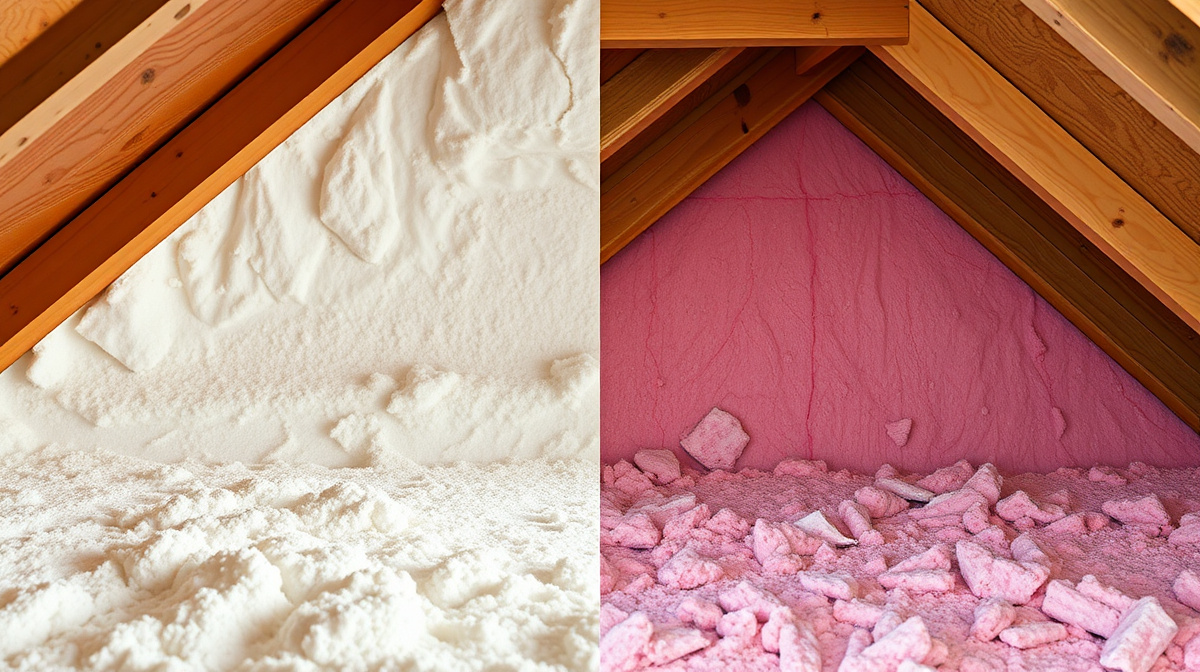
Spray foam and fiberglass are the two materials homeowners compare most often, and it's a fair fight — both are legitimate, widely used products, and neither one is a scam or an upsell. But they perform differently, cost differently, and suit different parts of a home. Here's a straightforward comparison so you can make the right call for your project instead of picking based on whichever one your neighbor happened to use.
R-value per inch
R-value measures resistance to heat flow — higher means better insulating performance for a given thickness. Standard fiberglass batts typically deliver around R-2.9 to R-3.8 per inch, depending on density. Open-cell spray foam typically lands in a similar-to-slightly-higher range around R-3.5 to R-3.7 per inch, while closed-cell spray foam delivers roughly R-6 to R-7 per inch — nearly double what fiberglass offers for the same thickness of material. That difference matters most in cavities with limited depth, like a rim joist or a shallow roof assembly, where closed-cell foam can hit a target R-value in far less space than fiberglass could.
Air sealing: the difference that matters most
This is where the two materials genuinely diverge, and it's arguably more important than the R-value comparison above. Spray foam expands to fill a cavity and cures as a continuous, adhered layer, which means it insulates and air-seals in a single application. Fiberglass batts, by contrast, only slow heat conduction through the material itself — they do nothing to stop air movement around gaps, penetrations, or a poorly fitted edge. A house can have technically adequate fiberglass R-value and still leak conditioned air freely through the same framing cavities the batts sit in.
In practice, this means fiberglass insulation typically needs a separate, deliberate air-sealing pass (caulk, foam sealant at penetrations, house wrap) to perform anywhere near its rated value, while spray foam largely handles that job as part of installation. It's a real advantage for spray foam, and it's also why an R-value comparison alone doesn't tell the whole story.
Cost comparison
Fiberglass is the clear budget option. Standard batts commonly run around $0.50 to $1.50 per square foot installed, making them the go-to choice for open wall cavities in new construction and remodels where cost efficiency matters. Spray foam costs more — commonly $1.00 to $3.00 per square foot for open-cell and $1.50 to $5.00 per square foot for closed-cell — because it's doing two jobs (insulating and air sealing) in one step and requires specialized equipment and installer training to apply correctly.
The honest way to frame the cost gap: fiberglass is cheaper per square foot, but you may need to budget separately for air sealing to get comparable real-world performance, which narrows the gap somewhat once you account for total project cost rather than material cost alone.
Moisture resistance
Closed-cell spray foam is largely resistant to moisture absorption and acts as a vapor retarder, which makes it a strong choice for crawl spaces, rim joists, and other areas exposed to dampness. Fiberglass, by contrast, can absorb and hold moisture if it gets wet, which reduces its insulating performance and can create conditions for mold growth if it stays damp. Open-cell spray foam sits in between — more moisture-tolerant than fiberglass, but not the vapor barrier that closed-cell provides. For consistently damp or humid spaces, closed-cell foam is generally the safer long-term choice.
Longevity and settling
Properly installed spray foam typically lasts the life of the building without settling or losing performance, since it cures into a fixed, adhered structure. Fiberglass batts are also long-lasting when installed correctly, but they're more vulnerable to real-world degradation over time — compression from stored items, settling in wall cavities, or damage from moisture or pests can all reduce a batt's effective R-value well before the material itself wears out. Correct initial installation (snug, gap-free, full cavity depth) matters enormously for how well fiberglass holds up over the years.
Which one is right for your home?
There's rarely a single right answer for an entire house — the strongest projects often use both materials where each one's strengths pay off.
- Choose closed-cell spray foam for crawl spaces, rim joists, roof decks, and any area where moisture resistance and maximum R-value per inch matter most.
- Choose open-cell spray foam for interior wall cavities and attic applications where air sealing and sound dampening are priorities and cost-efficiency matters.
- Choose fiberglass batts for open wall cavities in new construction or remodels where budget is the primary driver and a separate air-sealing pass is part of the plan.
- Combine materials when it makes sense — spray foam at the building envelope's most vulnerable points, fiberglass for straightforward, budget-conscious wall cavities elsewhere in the home.
Not sure which combination makes sense for your project? We'll walk your home, look at your specific cavities and climate goals, and recommend what actually fits your budget and performance needs — not just whichever product carries the biggest margin. Call 844-967-5247 for a free, no-pressure estimate.
Frequently asked questions
It depends on the application. Spray foam offers a higher R-value per inch (especially closed-cell) and air-seals as it insulates, which makes it stronger for crawl spaces, rim joists, and roof decks. Fiberglass is more budget-friendly and works well in open wall cavities when paired with proper air sealing. Neither is universally 'better' — the right choice depends on where in the home it's going.
Spray foam is a two-part chemical product applied with specialized, calibrated equipment by a trained technician, and it performs two functions at once — insulating and air sealing. Fiberglass is a simpler manufactured product that's faster and less specialized to install, which keeps its material and labor cost lower.
Yes. Fiberglass batts slow heat conduction through the material but don't stop air movement around gaps and penetrations. For fiberglass to perform close to its rated R-value, it typically needs a separate air-sealing pass — caulk, foam sealant, or house wrap — addressing the leaks the batts alone can't fix.
Yes, and it's often the smartest approach. Many well-built homes use closed-cell spray foam in moisture-prone or space-limited areas like crawl spaces and rim joists, and fiberglass batts in straightforward open wall cavities where budget efficiency matters more.
Ready for a free quote?
Tell us about your home and we'll build a clear quote — rebates included.